3. How the Minimax Algorithm Works in This Project
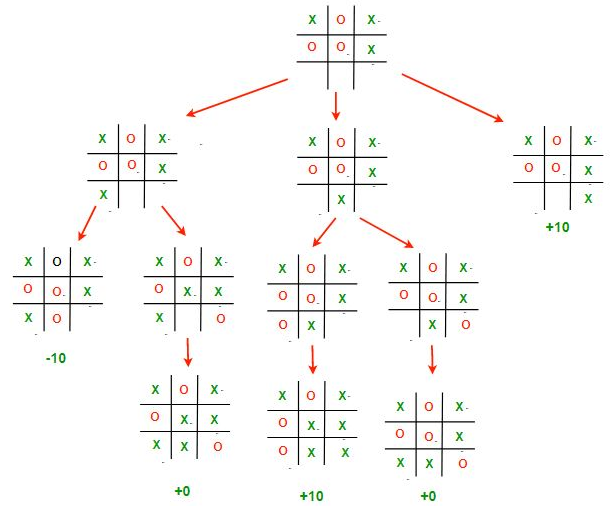
The Minimax algorithm is used to simulate all possible future moves and outcomes to help the AI pick the most advantageous move. It does so by treating the game as a tree of possibilities, with each node representing a board state and each edge representing a move.
Here's a theoretical breakdown of how minimax works in this Tic-Tac-Toe project:
1. Turn Simulation: At the AI's turn, it examines all possible cells where it can place its symbol
(O).
For each such move, it pretends to make that move and then simulates the opponent's possible responses
(X).
2. Recursive Evaluation: For every simulated move, the algorithm checks if the resulting board state
leads to a win, loss, or draw. If the game is not over, it recurses deeper, alternating between the
"maximizing" player (AI) and the "minimizing" player (human).
3. Scoring Terminal States: Once a terminal state (game over) is reached, it assigns a score:
- +1 if the AI (O) wins
- 0 if it's a draw
- -1 if the AI loses
4. Backtracking and Decision: As recursion unwinds, the algorithm propagates these scores upward. At
each level:
- The AI (maximizer) picks the move with the highest score.
- The human (minimizer) is assumed to pick the move with the lowest score.
5. Best Move Selection: Ultimately, the AI selects the move that leads to the path with the highest
guaranteed score (considering the human opponent will also play optimally). This ensures the AI never loses,
and it wins when possible.
The advantage of this approach is that it makes the AI unbeatable. While a human can still draw the game by playing perfectly, they will never be able to win against this AI.